Shoutouts: Teaching and Editing and Cooking for Writers

Forgive the rare Pollyanna-ish-ness, but I am feeling lucky to be working with some truly dear and talented and smart and funny people. My two colleagues Willie Fitzgerald and Christine Utz are teaching a class for HPE called “Opening Moves,” in which students learn how to make the first 50 pages of their novel (those critical pages for agents, editors, and bookstore perusers) excellent and addictive. I sat in on the class the other night— and in two weeks will lead a roundtable discussion with agent Susan Golomb and HarperCollins editor Ezra Kupor. That night Willie taught Tripwire, by Lee Child, a departure from the other novels they’ve studied, Luster and Nightbitch. Though I shared some backstory of what it was like for me to edit a short story by Lee, Willie was the star, with his energetic teaching and ability to touch on a ton of useful topics in a relatively short period of time, as well as his “Willie-isms,” as we call them, or bite-sized gems about writing and reading, like, “If it’s hot, write it cold.” (Meaning it’s best not to add dramatic or overly heightened prose to a very dramatic moment in your fiction.) Both Willie and Christine are gems themselves. If Willie and I tend to dive into our work with abandon, sometimes too much so, Christine, also a hard worker, is the more zen one in the group. She is the person who, in an apocalypse, would calmly slay and cook a squirrel, and then lead us to safety. When you find your people, workwise or otherwise, it’s a gift.
And although we work together less frequently, I’m also hugely lucky to have Michelle Wildgen as my co-host for The Breakthrough Writers Retreat. This is our small, cozy retreat on Cape Cod, where we gather to do individual coaching, write, discuss, and eat Michelle’s incredible food. Here’s a piece Michelle wrote for our newsletter, and I love how it captures the spirit of the retreat— and also my own values these days. We need all the community, variety of brainwork, warmth, and nourishment we can get.
Cooking for Writers
Last spring, before our first Breakthrough retreat, Heidi and I did so much advance shopping that we just barely fit it all into the car. I think I had a couple of grocery bags in my lap. It was clear we are both of the mindset that too much is better than too little, and also I live with a large man who has permanently skewed my sense of portion size. But once you do the yeoman’s work of shopping and hauling and unpacking, the cooking itself is a pleasure. Homemade granola and yogurt for breakfast, a big batch of soup and bread and fruit for lunch, Bolognese and vegan Bolognese or roasted chicken for dinner, wine, ice cream and chocolate, and there you have it.
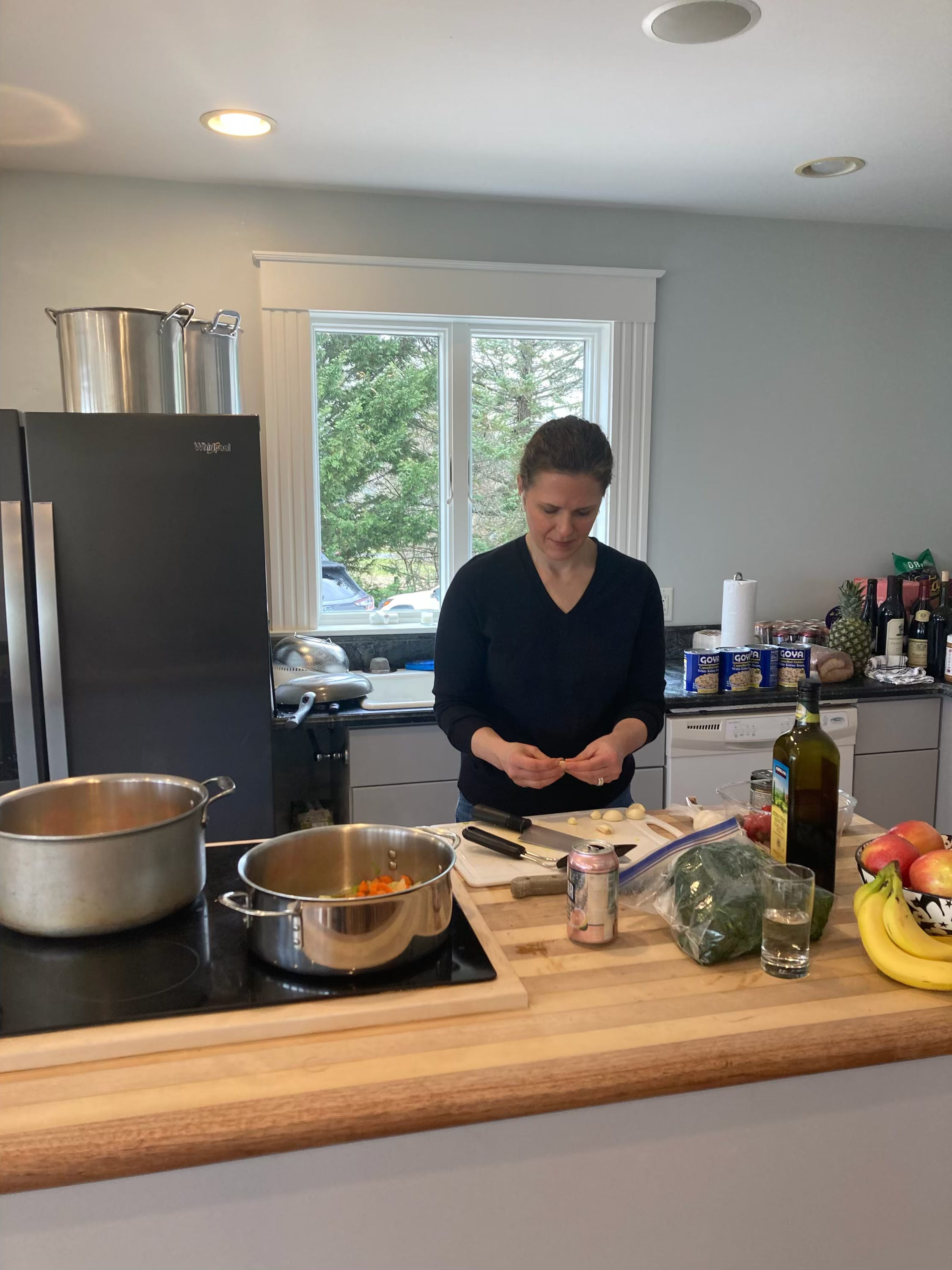
During the retreat, I spent the majority of the time, when I wasn’t working, in the kitchen, which was accessible to all the writers who were working nearby in the living room or in the adjacent cottages. Several people were concerned that I felt downtrodden doing all this cooking, and I understand why: I feel the same way when I watch people doing something I find to be tedious drudgery, like gardening or playing basketball. But cooking at the retreat was exactly what I wanted to do. I got to keep busy but in ways it was easy to stop in order to talk to writers; I could take a break from reading and writing and simply work with my hands; I derived what you might call a freakish pleasure from depleting the refrigerator supplies to the point where we would actually have room in the car on the way home.
I am a huge proponent of any kind of work that calls on a different part of the brain than you usually rely on. For me, that is something visual and something tactile. For you, it might indeed be gardening, or painting, or jogging or building or fixing something. Writers often believe that any break from writing is a failure of some kind, but I believe this misconception is the result of too many smug writers who lacked appropriate life boundaries. I feel the same way about forgetting to eat while writing—never, in all my years of writing, have I forgotten to eat. I consider food a fine reward for a good day’s work.
That is the other pleasure of doing the cooking for a small and hard-working group. People love to be handed a good plate of food that doesn’t make them feel like they just ate a stick of butter, but does feel satisfying and nourishing. They love to be served food they didn’t have to think about, plan, or prepare. They get to do what all of us, including me when I’m at my own retreat, love to do, which is work when I need to work and walk out of my brain fog to find a meal waiting for me. And then we can all dive right back in.
One of the best-loved meals last year was a kale, tomato and white bean soup that I make without a recipe when I have plenty of time to (though it is mostly hands-off) and need something so vegetable-abundant that it makes me feel a tiny bit immortal. I sauteed a few onions in olive oil, then added garlic, celery and carrot, and let it all take a good long while to develop some flavor. Don’t rush that part, because it is the basis of everything. Then I added diced tomatoes and let it simmer a while longer. Then broth, bay leaves, any kind of canned bean like cannellini or butter beans, and whatever seasoning I want; I think this time it was salt and pepper and thyme. Then I let it all simmer gently for maybe a half hour, maybe an hour. Finally, shredded kale, but you could do spinach or chard or any other green you like. I finish it with olive oil, lemon, and parmesan. I regard soup as an opportunity to have good bread, so we had some garlic-rubbed toast as well. And that was it, but this soup gives way more than it takes. It is substantial without being heavy, good for you without preening about it. I highly recommend you make it, or come to Cape Cod and ask me to make it for you. In the meantime, I am always taking dinner suggestions.